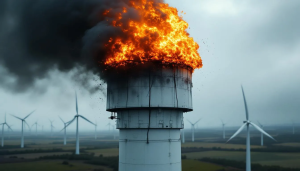
Wind farms have become one of the defining features of the modern energy landscape. From the plains of Texas to the waters of the North Sea, these clusters of towering turbines are transforming how we generate electricity and power our economies.
In this comprehensive guide, you’ll learn exactly how wind farms work, the different types available, where they’re built, and what challenges they face. Whether you’re exploring renewable energy options, considering a career in the sector, or simply curious about those spinning blades on the horizon, this guide covers everything you need to know.
Overview of Wind Farms
A wind farm—also called a wind park or wind power plant—is a cluster of wind turbines located in the same area and operated as a single power-generating facility. These installations convert the kinetic energy of moving air into clean electricity, feeding power into local grids or major transmission networks. The concept has ancient roots in windmills used for grinding grain, but modern electricity-producing wind turbines emerged in the late 19th century. Today’s multi-megawatt machines represent over a century of engineering refinement.
Wind farms are now central to global decarbonization strategies. The European Union has targeted climate neutrality by 2050, while the United States, China, and India have set similarly ambitious renewable energy goals. This isn’t just environmental policy—it’s increasingly driven by economics. Generation costs have plummeted from around $0.38 per kilowatt-hour in the 1980s to as low as $0.01–0.02/kWh in the 2020s, making wind one of the cheapest sources of new electricity in many regions.
Why wind farms matter:
-
Renewable and sustainable: Wind is driven by solar heating and Earth’s rotation, making it effectively inexhaustible
-
Scalable: Projects range from a few megawatts to multi-gigawatt installations
-
Cost-competitive: Dramatic cost reductions have made wind cheaper than new fossil fuel plants in many markets
-
Low emissions: Near-zero operational greenhouse gases compared to coal, oil, or gas plants
Wind farms are commonly categorized by their location relative to the coast: onshore (built on land), nearshore (within a few kilometers of the coastline), and offshore (in open water). Each type offers distinct advantages that we’ll explore in detail below.
What Is a Wind Farm and How Does It Work?
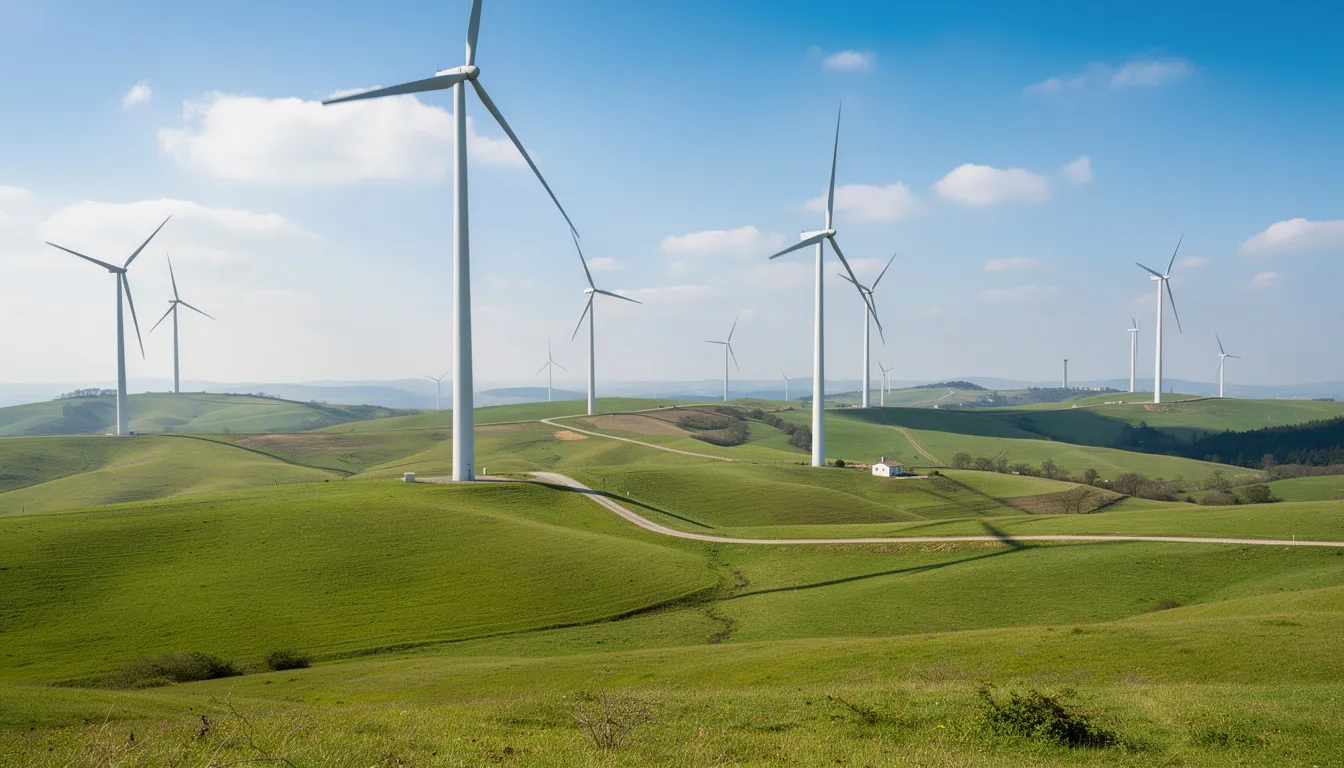
A wind farm is a site containing multiple wind turbines that feed electricity into the grid through shared electrical infrastructure. Think of it as a power generation facility where each turbine acts as an individual generating unit, but all are connected to a common substation that collects their output, steps up the voltage, and sends the power to customers through transmission lines.
Each turbine operates on a simple principle. As wind flows over the turbine blades—shaped like aircraft wings—it creates a pressure difference that generates aerodynamic lift. This lift causes the rotor to spin. The rotating rotor connects to a generator inside the nacelle (the housing at the top of the tower), where electromagnetic induction converts mechanical power into electricity. Transformers then raise the voltage for efficient transmission across the electric grid.
Modern horizontal-axis wind turbines consist of several key physical components: the tower (which elevates the rotor to access stronger winds at height), the nacelle (containing the gearbox, generator, and control systems), the rotor and blades (typically three blades attached to a central hub), the yaw system (which rotates the nacelle to face the wind direction), and the pitch system (which adjusts blade angle to control power output and protect the machine in high winds).
Turbine capacity has grown dramatically over the decades. First-generation commercial turbines in the 1980s produced about 50 kW (0.05 MW) with rotor diameters under 30–40 meters. By the 2010s, typical onshore turbines reached 2–3 MW with rotors spanning 80–120 meters. Today’s largest offshore wind turbines generate 5–15 MW each, with rotor diameters exceeding 150 meters. A wind farm’s total capacity is simply the sum of its turbines—multi-hundred-megawatt onshore projects are common, while the largest offshore installations now exceed 1 GW.
Types of Wind Farms
Wind farms are commonly categorized by their location relative to the coast and the sea: onshore, nearshore, and offshore. This classification isn’t just about geography—it fundamentally affects wind resource quality, construction cost, operation and maintenance requirements, and environmental footprint.
Each type suits different conditions and project goals. Onshore farms benefit from lower costs and easier access. Nearshore projects capture coastal wind patterns while maintaining land-based logistics. Offshore installations access the strongest, most consistent winds but require specialized marine infrastructure.
Onshore Wind Farms
Onshore wind farms are built on land, typically more than about 3 km from the coastline, using predominantly terrestrial wind patterns. They represent the most widespread and mature form of wind power deployment globally.
The main advantages of onshore wind farms include relatively lower construction and maintenance costs compared to offshore alternatives. Ground access simplifies installation—heavy cranes can erect towers and blades without specialized vessels. Grid connection distances are typically shorter, reducing cable costs. These factors have made onshore wind one of the cheapest sources of new power generation in many countries.
Typical onshore turbines range from 2–6 MW each, with overall project capacities spanning from tens of megawatts for smaller installations to multi-gigawatt complexes in regions with exceptional wind energy resources. China’s Inner Mongolia wind power bases, the sprawling farms across West Texas, and developments in Rajasthan, India, demonstrate the scale now achievable on land. The Gansu Wind Farm in China, for example, has a planned capacity exceeding 10 GW across multiple phases.
Developers prefer sites with open plains, ridgelines, and mountain passes that offer strong, steady winds with minimal obstacles. The Tehachapi and Altamont passes in California became early proving grounds for large-scale wind development precisely because of their exceptional wind corridors.
Onshore wind farm advantages and constraints:
-
Lower capital and maintenance costs than offshore
-
Easier access for construction and repairs
-
Potential land use conflicts with agriculture, housing, or recreation
-
Visual impact on landscapes can generate local opposition
-
Noise considerations require setbacks from homes
Nearshore Wind Farms
Nearshore wind farms occupy a middle ground—projects located on land within roughly 3 km of the coastline, exposed to both land and sea breezes. These sites capture the benefits of more regular coastal winds while retaining relatively straightforward land-based construction and access.
The hybrid resource advantage is significant. Coastal areas often experience stronger and more consistent wind patterns than inland sites due to the temperature differential between land and sea. At the same time, developers avoid the substantial costs and logistical complexity of marine construction. Many nearshore sites can leverage existing coastal industrial or port infrastructure for logistics, staging, and grid connections.
Regional examples include the coastal wind belts along Northern Europe’s shores and developments near the US Great Lakes shoreline, where proximity to water creates favorable wind conditions without requiring offshore foundations.
Key characteristics of nearshore wind farms:
-
Access to more consistent coastal wind patterns
-
Land-based construction keeps costs lower than offshore
-
Can utilize existing port and grid infrastructure
-
May face coastal zoning restrictions or tourism-related concerns
-
Exposed to salt spray and coastal weather conditions
Offshore Wind Farms
Offshore wind farms are located in open water—typically several kilometers or miles from the coast—either fixed to the seabed or using floating foundations in deeper waters. They represent the fastest-growing segment of the wind industry and offer access to the strongest, most consistent wind energy resources available.

The technical advantage is compelling. Marine winds are stronger, more consistent, and less turbulent than those over land. This allows offshore wind turbines to achieve higher capacity factors—often 40–50% or more compared to 30–40% for typical onshore sites. The open sea environment also enables much larger turbines. Modern offshore machines commonly range from 8 to 15 MW each, with next-generation prototypes already exceeding those figures. Future blades will exceed 200 meters in length, enabling unprecedented energy capture per turbine.
Leading offshore wind farms include Hornsea 2 in the UK (approximately 1.3 GW), Dogger Bank (under construction with a planned capacity exceeding 3.6 GW across phases), and Vineyard Wind off the east coast of Massachusetts—the first utility-scale offshore wind project in the United States. Asia is expanding rapidly, with major developments in Taiwan, Japan, and South Korea.
Construction and maintenance costs are significantly higher than onshore. Specialized vessels are required for foundation installation, turbine erection, and ongoing operation. Dedicated offshore substations aggregate turbine output before transmitting power to shore via subsea cables. Projects more than 50–100 km offshore may use HVDC (high-voltage direct current) transmission for efficiency.
Offshore wind farm trade-offs:
-
Access to stronger, more consistent winds and higher capacity factors
-
Enables very large turbines (8–15+ MW each)
-
Minimal visual impact for coastal communities when sited far from shore
-
Substantially higher construction and O&M costs
-
Environmental and radar concerns require careful assessment
-
Complex permitting involving multiple agencies including ocean energy management authorities
Siting and Design of Wind Farms
Choosing where to build a wind farm is a multi-factor optimization problem. Developers must balance wind resource quality, grid access, engineering constraints, and community and environmental impacts. A windy site means nothing if there’s no transmission capacity to deliver the power—or if permitting obstacles make the project unbuildable.
The development process typically begins with regional wind maps and resource screening. Promising sites then undergo multi-year on-site measurements before developers commit to final design and financing. The process can take 5–10 years from initial concept to commercial operation, particularly for offshore wind projects that require extensive federal government approvals.
Wind Resource and Terrain
Long-term wind speed and wind direction data are collected using meteorological masts equipped with anemometers and wind vanes at multiple heights. Many developers supplement these measurements with LiDAR (Light Detection and Ranging) or SoDAR (Sonic Detection and Ranging) systems that can profile the wind across the entire rotor-swept area, often over 1–3 years of continuous monitoring.
Key metrics for turbine selection and layout include average wind speed (typically 7–8+ m/s at hub height for utility-scale projects), turbulence intensity (which affects fatigue loads and component lifetime), wind shear (how speed changes with height), and extreme gusts (which determine structural requirements). Wind speeds generally increase with height—a turbine at 250 feet accesses winds about 20% stronger than one at 150 feet—but air density decreases with temperature and altitude, affecting total energy production.
Terrain shapes the wind resource dramatically. Hills and ridges can accelerate flow, creating local speed-ups that developers exploit. Valleys can channel winds but may also create turbulence. Forests, buildings, and other obstacles generate wind shadows and unstable flow that reduce output and increase mechanical stress. Well-known wind corridors like California’s Tehachapi Pass or similar mountain passes elsewhere exist because topography naturally funnels and accelerates air movement.
What developers check before committing to a site:
-
Multi-year wind speed statistics and frequency distributions
-
Extreme gust and storm conditions for structural design
-
Turbulence intensity and directional variability
-
Icing risk in cold climates (can reduce output and create safety hazards)
-
Terrain effects on flow quality
Electricity Grid and Layout Considerations
Access to high-voltage transmission lines and available transfer capacity is critical for project viability. Even exceptionally windy sites may not be economically viable if they’re hundreds of kilometers from the nearest substation or if the grid is already congested. Developers must apply to grid or system operators—such as ISOs (Independent System Operators) or TSOs (Transmission System Operators)—for interconnection rights, often entering long queues that can delay projects by years.
Basic layout principles balance energy capture against infrastructure costs. Turbines are spaced several rotor diameters apart in the prevailing wind direction to reduce wake effects—the slower, more turbulent air downstream of each turbine. Manufacturers generally recommend at least 3.5 times the rotor diameter of clear space between adjacent turbines, with many layouts using 5–9 rotor diameters in the main wind direction and somewhat less perpendicular to it.
Offshore layouts must consider water depth (which determines foundation type), seabed geology, shipping lanes, fishing areas, and cable routing to offshore substations. Floating foundations are expanding the buildable area into deeper waters where fixed-bottom structures aren’t feasible.
Main grid-related questions for wind projects:
-
Is sufficient transmission capacity available, or are upgrades needed?
-
What’s the distance to the nearest suitable substation?
-
What grid code requirements apply (voltage control, frequency support, fault ride-through)?
-
Are there interconnection queue delays that could affect project timeline?
Environmental and Community Assessments
Environmental impact assessments (EIAs) examine potential effects on birds, bats, habitats, marine life (for offshore projects), and landscape character. National or regional agencies often publish siting guidelines and require formal permitting processes that can take years to complete. In the United States, offshore wind projects must navigate reviews by multiple agencies including those responsible for ocean energy management and coast guard safety requirements.
Developers conduct visual impact analyses, noise modeling, and sometimes shadow-flicker studies for onshore projects near homes. Setback regulations—requiring minimum distances between turbines and residences—help manage these concerns. Public consultation involves meetings with local communities, landowners, fishers, and other marine stakeholders to address concerns and negotiate mitigation measures.
Typical mitigation measures:
-
Setback distances from homes, roads, and boundaries
-
Curtailment (temporary shutdown) during peak bird or bat migration periods
-
Careful cable routing to avoid sensitive marine habitats
-
Decommissioning plans and financial guarantees for end-of-life site restoration
-
Community benefit programs and land lease payments
Global Scale and Notable Wind Farms
Global installed wind capacity now exceeds 900 GW and continues growing rapidly. Wind power has become one of the world’s leading sources of new electricity generation, with usage growing 20–25% annually through much of the early 21st century. Both onshore and offshore development continue to accelerate as costs fall and climate policies tighten.
China leads the world in total wind capacity by a substantial margin, followed by the United States, Germany, India, Spain, and Brazil. China alone installed more wind capacity in recent years than the rest of the world combined. The European Union has pioneered offshore wind development, but Asia and North America are catching up quickly. The east coast of the United States has multiple large offshore wind projects in development, including Vineyard Wind, Empire Wind, and Revolution Wind.
Many regions plan massive future build-outs. Offshore development is expanding beyond traditional North Sea locations into the Baltic Sea, Mediterranean, and waters off Asia and the Americas. Floating wind technology is opening deep-water sites previously considered unbuildable.
Representative flagship wind projects worldwide:
-
Gansu Wind Farm (China): Multi-phase onshore complex with planned capacity exceeding 10 GW
-
Hornsea Project One and Two (UK): Offshore farms totaling over 2.5 GW in the North Sea
-
Alta Wind Energy Center (USA): One of the largest onshore wind farms in the United States at approximately 1.5 GW in California
-
Dogger Bank (UK): Under construction, will be among the world’s largest offshore installations at 3.6 GW+
-
Vineyard Wind (USA): First utility-scale offshore wind farm in the United States, with additional east coast projects in development
Benefits of Wind Farms
Wind farms are central to renewable energy strategies because they provide large-scale clean electricity with low direct emissions. As countries work to reduce dependence on fossil fuels and meet climate commitments, wind power has become one of the fastest-growing components of the global energy mix.
Climate and air-quality benefits are substantial. Wind turbines produce near-zero operational greenhouse gas emissions—no combustion, no CO2, no sulfur dioxide, no nitrogen oxides, no particulates. While manufacturing and construction do involve some emissions, life-cycle analyses consistently show wind’s total carbon footprint is a small fraction of fossil fuel alternatives. Every megawatt-hour generated by wind displaces generation from coal, oil, or gas plants, directly reducing emissions that drive climate change.
Economic benefits extend across communities. Wind projects create jobs in manufacturing, construction, operation, and supply chain support. Landowners hosting turbines receive lease payments—often a significant income diversification for farmers and ranchers. Rural and coastal areas that might otherwise see limited development gain investment, tax revenue, and infrastructure improvements.
Energy-system advantages include supply diversification, reduced fuel import dependence for countries without domestic fossil resources, and predictable operating costs. Unlike gas or coal plants, wind farms face no fuel price volatility—the wind is free.
Summary of wind farm benefits:
|
Category |
Key Benefits |
|---|---|
|
Environmental |
Near-zero operational greenhouse gases; no air pollutants; low life-cycle emissions |
|
Economic |
Jobs in manufacturing, construction, O&M; landowner lease income; regional development |
|
Energy Security |
Diversified supply; reduced fuel imports; stable operating costs |
|
Scalability |
Projects range from tens of MW to multi-GW installations |
Challenges and Impacts of Wind Farms
While wind farms have comparatively low environmental footprints compared to fossil fuel plants, they do present technical, ecological, and social challenges. Understanding these issues—and the mitigation strategies available—is essential for anyone working with or affected by wind development.
This section covers grid integration, environmental and landscape impacts, radar and radio interference, and sector-specific effects on agriculture and marine ecosystems.
Effect on the Environment and Landscape
Wind power’s life-cycle greenhouse gas emissions are much lower than those of coal, oil, or gas plants—but not entirely zero. Manufacturing turbine components (especially steel towers and fiberglass blades), constructing foundations, and transporting equipment all involve energy use and emissions. However, these are typically “paid back” within months of operation through avoided fossil fuel generation.
Visual and land-use impacts are often the most contentious issues for onshore wind farms. Modern turbines can stand 150+ meters tall with blades visible over distances of many kilometers. Some communities perceive wind development as “industrialization” of rural landscapes. Noise from blade rotation—while generally meeting regulatory limits at required setback distances—can still concern nearby residents.
Wildlife collisions, especially for birds and bats, require careful attention. Impacts can be mitigated through proper siting away from key migration routes, curtailment during high-risk periods, and monitoring programs that adjust operations based on real-time observations. Habitat fragmentation from access roads and construction areas is generally modest compared to other forms of development.
End-of-life challenges for large composite blades have drawn attention. While towers and mechanical components are readily recyclable, fiberglass blades have historically gone to landfills. Ongoing industry efforts focus on improved recycling technologies and development of recyclable blade materials.
Main environmental impacts and mitigation strategies:
-
Visual impact: Careful siting, community engagement, benefit-sharing
-
Noise: Setback requirements, operational constraints at night
-
Wildlife collisions: Siting away from migration corridors, curtailment programs
-
Blade disposal: Emerging recycling technologies, alternative materials
Effect on the Power Grid
Wind power is variable and partly unpredictable, which can complicate balancing supply and demand as its share of electricity grows. The wind doesn’t blow on demand—output fluctuates with weather patterns, sometimes dropping to near zero during calm periods and surging during storms.
Grid operators use several tools to manage this variability. Improved wind forecasting—leveraging weather models and machine learning—provides advance warning of output changes. Flexible backup generation from gas turbines or hydropower can ramp up and down to compensate. Demand response programs shift electricity consumption to match available supply. Energy storage (batteries, pumped hydro) is increasingly deployed alongside wind farms. Stronger interconnections between regions smooth variability because weather systems move across areas at different times.
Wind farms must meet grid-code requirements for voltage control, fault-ride-through capability (staying connected during grid disturbances), and frequency support. Power electronics in modern turbines can provide these services, but grid operators may require additional equipment or operational constraints.
Geographic dispersion helps—when farms are spread across a region or country, the aggregate output is much smoother than any single location. This portfolio effect is a key argument for building diverse, distributed renewable generation rather than concentrating capacity in a few locations.
Technical tools for grid integration:
-
Advanced wind forecasting and scheduling
-
Flexible backup generation and demand response
-
Battery and pumped-hydro energy storage
-
Stronger transmission interconnectors between regions
-
Grid-forming inverters and synthetic inertia from power electronics
Ground Radar Interference
Large moving turbine blades can reflect and Doppler-shift radar signals, sometimes mimicking aircraft or weather patterns in military, aviation, or meteorological radar systems. This radar interference has delayed or reshaped wind projects in several countries, prompting ongoing collaboration between developers, defense agencies, and air-traffic authorities.
Interference can manifest as cluttered radar screens, false targets, or reduced ability to detect real aircraft or storms behind or within a wind farm. The severity depends on radar technology and software, turbine height and blade design, and the distance and orientation relative to the radar installation. Coast guard and other marine first responders may also rely on radar systems that could be affected by offshore installations.
National security issues have prompted some countries to establish exclusion zones around radar installations or require mitigation measures as conditions of project approval. Officials charged with managing airspace and defense have become key stakeholders in wind farm siting.
Mitigation options and planning practices:
-
Software filtering to remove turbine returns from radar displays
-
Relocation or upgrade of affected radar systems
-
Modified turbine materials or blade coatings to reduce reflections
-
Early coordination with aviation and defense agencies during project planning
-
Infill radar or gap-filling technologies to maintain coverage
Radio and Television Reception Interference
Wind turbines can sometimes scatter or block radio, TV, and microwave communication links, especially when turbines sit directly in the path between transmitters and receivers. This interference affects a smaller number of projects than radar concerns but can still create issues for affected communities.
Developers typically use predictive modeling during planning to assess potential interference with broadcast or communication services. The analysis considers turbine locations, heights, and blade materials relative to known transmitter and receiver positions.
Assessment and mitigation steps:
-
Pre-construction interference modeling for broadcast and microwave links
-
Slight relocation of turbines to avoid direct signal paths
-
Adjustment of antenna directions for affected receivers
-
Installation of repeaters or alternative links for impacted communities
-
Post-construction monitoring and remediation if issues arise
Effects on Agriculture and Rural Land Use
Onshore wind farms are often built on farmland, where turbines and access roads occupy only a small percentage of the total land footprint. Standard agricultural operations—cropping, grazing, hay production—typically continue right up to the base of the towers.
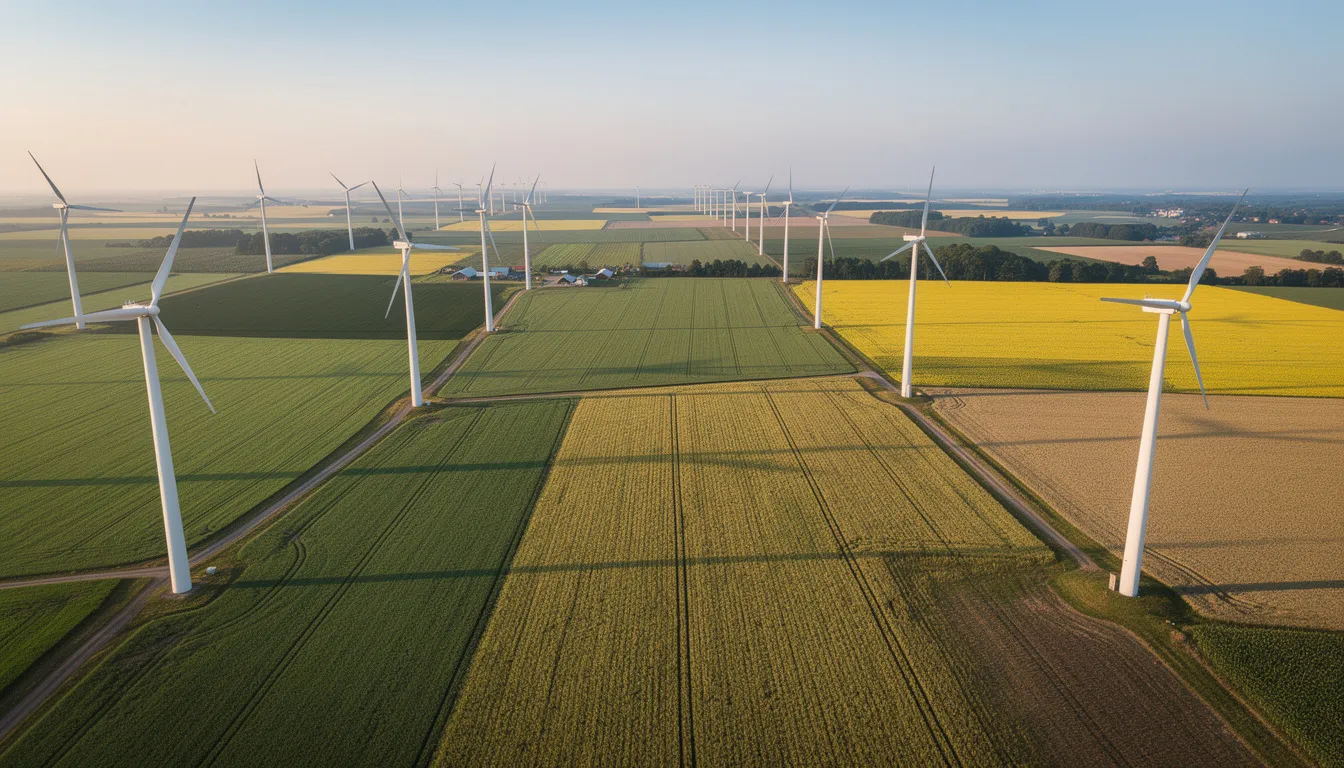
Research indicates that turbine-induced turbulence can slightly alter local microclimates near the ground. Mixing of air layers may reduce frost risk at night and affect moisture or disease patterns for crops. Some studies suggest potential benefits for certain crops (such as corn and soybeans) from improved air circulation around fields near turbines, though effects vary by location and conditions.
For farmers, wind farms often represent meaningful income diversification. Lease payments for hosting turbines—typically ranging from a few thousand to tens of thousands of dollars per turbine annually—provide stable revenue independent of commodity prices. Improved access roads and grid connections built for the wind project may benefit farm operations as well.
Agricultural impacts at a glance:
-
Turbines occupy small footprint; farming continues between and around towers
-
Microclimate effects from air mixing can reduce frost risk
-
Potential benefits for some crops from increased air circulation
-
Lease payments provide stable income for landowners
-
Improved roads and infrastructure may benefit farm operations
Effects on Marine Life
Offshore wind farms can alter marine habitats in complex ways. Foundations and scour protection structures—the rock and gravel placed around bases to prevent erosion—may act as artificial reefs, changing local biodiversity by providing hard substrate in otherwise sandy or muddy environments.
During construction, pile-driving to install foundations generates significant underwater noise that can disturb marine mammals and fish. Timing restrictions (avoiding sensitive breeding or migration periods), bubble curtains that dampen sound transmission, and use of alternative foundation types can reduce these impacts. Vessel activity during construction and operation also affects the marine environment, though effects are generally localized.
Long-term studies in European offshore wind farms suggest that, in some regions, structures can increase habitat complexity and support higher local marine life abundance and diversity. Fish populations may grow around foundations, and exclusion of fishing from operational areas can create de facto marine reserves. However, outcomes vary by species and site conditions, and long-term monitoring programs continue to build understanding.
Marine life considerations:
|
Phase |
Potential Impacts |
Mitigation Approaches |
|---|---|---|
|
Construction |
Pile-driving noise affects marine mammals and fish |
Timing restrictions, bubble curtains, alternative foundations |
|
Operation |
Artificial reef effects, vessel traffic, electromagnetic fields from cables |
Careful cable burial, operational monitoring |
|
Long-term |
Potential increase in local biodiversity; exclusion of fishing from some areas |
Ongoing research and adaptive management |
Policy, Markets, and Future Developments
Wind farm deployment is strongly influenced by national and regional policies. Renewable portfolio standards require utilities to source specified percentages of electricity from renewables. Competitive auctions drive down contract prices. Tax credits (like the US Production Tax Credit) and feed-in tariffs in various countries have accelerated development. The federal government plays a critical role in permitting offshore wind projects and setting lease terms for ocean areas.
Long-term climate targets—including mid-century net-zero commitments—create sustained policy demand for new wind capacity. Corporate power purchase agreements, where companies contract directly to buy wind output, have become a major market driver. Energy infrastructure investment is increasingly shaped by climate risk and the desire for energy security in an uncertain geopolitical environment.
Market trends point toward continued evolution. Very large offshore wind projects are becoming the norm, with single phases exceeding 1 GW. Floating wind technology is maturing, opening deep-water sites that vastly expand the available resource. Turbine sizes continue to grow—future blades will exceed 200 meters, and individual machines may reach 20+ MW. Digitalization, data analytics, and AI are optimizing turbine placement, predicting maintenance needs, and maximizing efficiency. Empire meets regularly with grid operators to ensure seamless integration of new offshore capacity.
Public acceptance remains critical. Weekly meetings and ongoing press release updates from developers help maintain community support. Stable regulation, streamlined permitting, and grid upgrades are essential to sustain rapid growth. The department responsible for energy policy in each country sets the framework that determines how quickly wind can scale.
Key future directions for wind farms:
-
Larger turbines with rotors exceeding 200 meters for greater energy capture
-
Floating offshore platforms accessing deep-water wind energy resources
-
Hybrid wind-solar-storage projects sharing grid connections and land
-
Grid modernization including transmission upgrades and smart inverters
-
Improved blade recycling and sustainable manufacturing practices
-
Integration with green hydrogen production for storage and industrial use
Wind farms have evolved from experimental curiosities to essential energy infrastructure in just a few decades. With continued innovation, supportive policies, and careful attention to environmental and community concerns, wind power is positioned to prevent impacts of climate change while delivering affordable, reliable electricity to customers worldwide.
Whether you’re evaluating career opportunities in renewable energy, assessing investment options, or simply trying to understand the turbines on your horizon, understanding wind farms is increasingly essential. The industry continues to operate at unprecedented scale, and the next decade will likely bring even larger projects, smarter technology, and deeper integration into the global energy system.